
A buzz cut for a receding hairline is one of the most practical hairstyles men choose when temples thin or the front hairline moves back. It reduces contrast between dense sides and sparse areas, looks intentional instead of accidental, and takes minutes to maintain each week. For many patients, it is a smart short-term style while they decide whether medical treatment or a hair transplant may be suitable.
The buzz cut does not stop hair loss. It changes how thinning is perceived. When longer hair falls flat, recession looks sharper. When everything is clipped evenly, the eye reads one cohesive texture. That is why barbers and hair specialists often recommend a short clipper cut before discussing FUE, DHI, PRP, or other options.
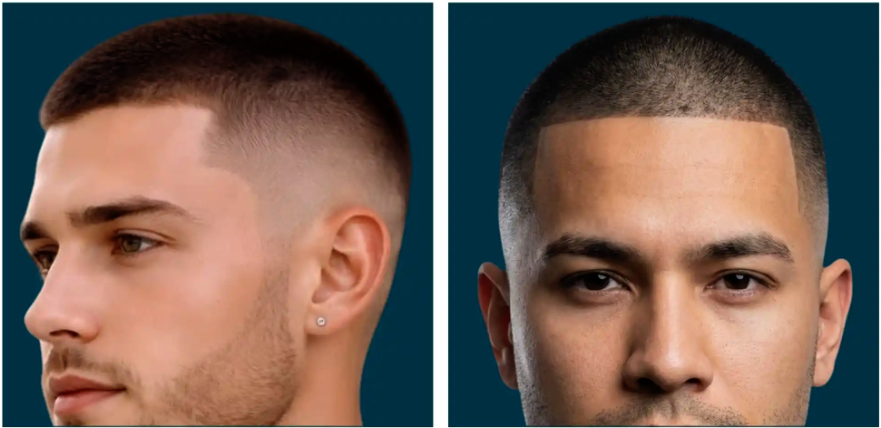
Choosing the right guard length, fade, beard balance, and lineup matters as much as going short. A #0 skin buzz on the wrong face shape can emphasize a long forehead. A soft #2 with a temple fade can look modern and balanced on early recession. Norwood stage, temple vs crown pattern, and bone structure all influence the best buzz cut for receding hairline goals.
At Turkus Hair Transplant Clinic in Spain, patients often ask whether a buzz cut is enough or when surgical planning makes more sense. Honest answer: grooming can improve appearance today. Progressive M-shaped hairline change or visible scalp at the crown may still need evaluation. Results vary between patients; consultation is recommended when styling alone no longer feels sufficient.
Specialists at Turkus Hair Transplant Clinic, Spain note: "A well-executed buzz cut is not giving up. It is controlling the visual story while you decide on medical care, PRP, or transplant timing. We plan from photos and pattern, not from trends alone."
Quick Insights
- A buzz cut for receding hairline reduces contrast between thick sides and thin temples or front.
- It does not slow hair loss, but it can make thinning look cleaner and more intentional.
- Guard lengths #0 to #3 change how much scalp shows and how sharp recession appears.
- Early temple recession often suits #2 or #3 with a soft fade; advanced loss may need a shorter uniform look or shaved head comparison.
- Norwood 2 to 5+ patterns benefit from different lengths, lineups, and beard framing.
- Temple recession and crown thinning are different visual problems; one buzz style does not fit every pattern.
- Buzz cut vs shaved head: buzz keeps subtle texture; shaved removes all length and maximizes simplicity.
- Face shape guides whether you add height on top, keep sides tight, or soften the hairline edge.
- Beard and sideburn styles should match clipper length so the face looks balanced.
- Myth busted: shorter hair does not make follicles thicker; it only changes how hair is seen.
- After FUE or DHI, a buzz cut may be part of recovery styling once your team approves clipping.
- Free hair analysis in Spain helps separate mature vs receding change from progressive loss that may need treatment.
Why a Buzz Cut Works for a Receding Hairline
Hair loss is visible partly because of contrast. When the hairline recedes, longer hair on top can flop forward and expose sparse temples. Under bathroom light, the difference between dense sides and thin front zones becomes obvious. A buzz cut lowers that contrast by bringing most of the scalp to a similar length.
Contrast is what the eye notices
Recession looks worse when dark long hair surrounds a bright scalp triangle at the temples. Clipping everything short makes color and shadow more even. The hairline still recedes, but the style looks chosen rather than hidden. That psychological shift matters for confidence at work, gym, and social settings.
Low maintenance fits active routines
Men who travel, exercise daily, or dislike blow-drying often prefer a buzz cut. There is no styling product routine, minimal bed-head, and easy refresh every one to two weeks at the barber or with home clippers. For progressive thinning, predictable upkeep beats fighting a hairstyle that no longer suits density.
Specialists at Turkus Hair Transplant Clinic, Spain note: "When patients show me photos with longer hair combed over thin temples, the recession often looks more dramatic than on a short clipper cut. Reducing contrast is a legitimate grooming strategy while we assess whether medical or surgical options may help."
Works with medical and surgical planning
A buzz cut pairs well with minoxidil, finasteride where prescribed, PRP supportive care discussed at consultation, and post-transplant phases after grafts stabilize. It does not replace treatment. It keeps appearance controlled while you track shedding, density, and goals with a specialist.
Honest limits
If the crown is very thin or the hairline has moved back several centimeters, even a perfect buzz cut cannot recreate a youthful frame. At that point, hairline design, beard transplant framing, or FUE to rebuild the front may be discussed. A buzz cut remains useful before and after those steps, but it is not a substitute for restoring lost territory when that is your goal.
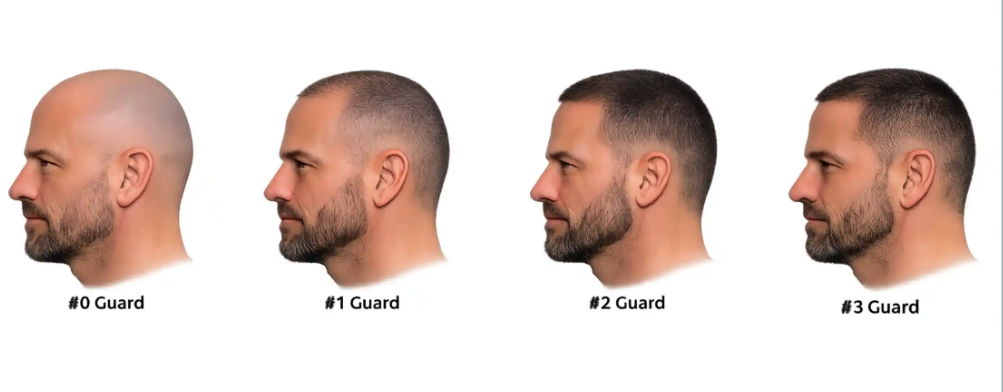
Buzz Cut Guard Lengths: #0 to #3 Explained
Clipper guard numbers describe how much hair stays on the scalp. Lower numbers mean shorter cuts. For a receding hairline, the right guard changes how much skin shows at the temples and whether the top looks fuller than the front.
Guard #0 and #0.5 (skin close)
A #0 or bald fade buzz removes almost all visible length. It maximizes uniformity when loss is advanced or when you prefer a very clean military look. The trade-off: scalp texture, sun exposure, and every millimeter of recession become visible. Some men love the honesty; others find it too stark early in the journey.
Guard #1 (about 3 mm)
A #1 buzz leaves a faint shadow of hair. It softens the scalp look slightly while staying extremely short. Good for men who want near-shaved simplicity without full blade exposure. On an M-shaped hairline, the front may still look lighter than the sides, but the overall silhouette stays tight.
Guard #2 (about 6 mm)
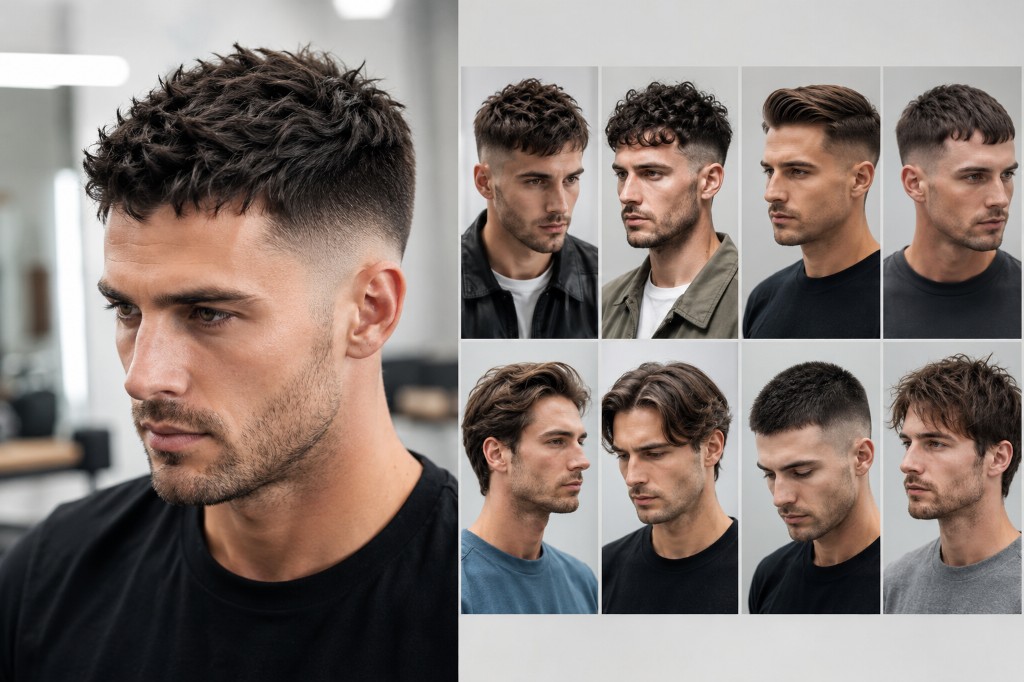
A #2 buzz is one of the most popular choices for early to moderate recession. Enough pigment remains to blur thin spots while the cut still looks modern. Many barbers pair a #2 top with a #1 or skin fade on the sides for structure. This length often photographs well and suits men's hairstyles for thin hair when you are not ready to go fully shaved.
Guard #3 (about 10 mm)
A #3 buzz feels short but not severe. It can work when loss is mild, when you are transitioning from a longer cut, or when your hair is very coarse and still looks dense at this length. The risk: if temples are very thin, #3 may expose patchiness more than #2 because hair stands differently. Your barber can test a higher guard first and step down gradually.
Specialists at Turkus Hair Transplant Clinic, Spain note: "I tell patients to bring reference photos and start one guard longer than they think they need. You can always go shorter in the same visit. Jumping straight to #0 on early recession sometimes adds stress without benefit."
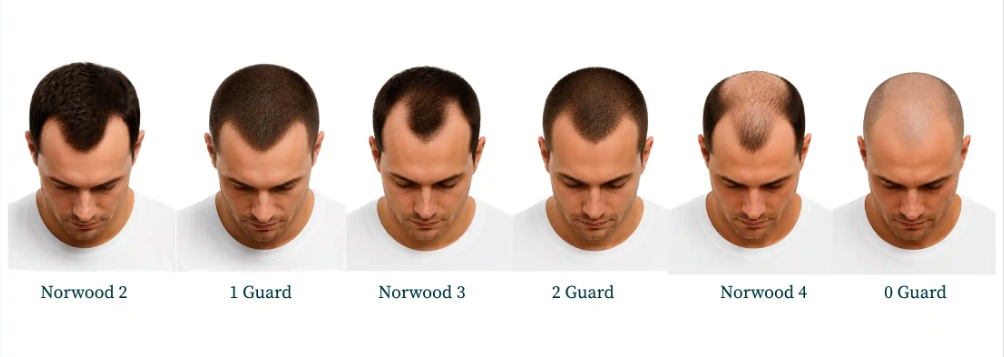
Buzz Cut by Norwood Stage (2 to 5+)
Norwood scale stages describe typical male pattern progression. Your stage influences how aggressive a buzz cut should be and whether grooming alone still meets your goals.
Norwood 2 to 3: early temple recession
At Norwood 2 or 3, recession is often limited to temples or a slight M-shaped hairline. A #2 or #3 buzz with a soft temple fade usually looks balanced. Keep the lineup natural, not razor sharp into empty corners, unless you deliberately choose a faded stubbled edge. This is the stage where mature vs receding assessment matters: a mature hairline can look good with a short cut and no surgery.
Norwood 3 vertex to 4: temples plus crown change
When thinning spreads to the crown, uniform length becomes more important. A consistent #1 or #2 all over avoids a bald spot surrounded by longer sides. Sideburn styles should taper cleanly into facial hair so the eye travels smoothly from ear to jaw. Medical options and PRP may be discussed if shedding accelerates.
Norwood 5 to 5+: advanced pattern
Advanced stages leave a narrower band of native hair. Many men choose a #0 or #1 full buzz or move toward a shaved head aesthetic. Beard density matters more because the lower face frames what remains on top. Transplant candidacy depends on donor area, goals, and realistic hairline design. A buzz cut still helps you look groomed while planning.
Norwood 6 to 7: extensive loss
With extensive loss, the buzz cut and shaved head decision is mostly about personal taste and scalp comfort. Some prefer a daily razor or weekly #0 clipper pass. Others keep a #1 shadow. Surgical options may focus on a conservative front frame or beard transplant balance rather than full density restoration. Expectations should stay personalized; no result is guaranteed for every patient.
Temple Recession vs Crown Thinning
Not all receding hairline buzz cut strategies fit crown thinning. Temple loss changes the front frame. Crown loss changes the top silhouette when viewed from behind and under overhead light.
Temple-predominant recession
When the issue is mainly temples, a buzz cut with a gradual fade at the sides can soften the M shape. Avoid heavy fringe styling that points to sparse corners. A beard with controlled width can add lower-face balance. If you are considering FUE, temple points are part of hairline design conversations, not just barber lineups.
Crown-predominant thinning
Crown thinning shows as a swirl or bright spot under bathroom lighting. Longer hair around it creates a tonsure effect. Clipping the whole head to #1 or #2 removes that halo. If the front is still strong, some men keep a slightly longer top for shape; others go uniform for simplicity.
Combined patterns
Most men eventually see both temple and crown change. A single guard all over is often the cleanest answer. Layered barber tricks that work on full heads can fail when density is uneven. Photos from above, front, and sides help your barber or clinic team see the full pattern.
Specialists at Turkus Hair Transplant Clinic, Spain note: "Patients sometimes ask only about the front hairline in the mirror and forget the crown. A good plan, surgical or not, looks at both. Buzz cut length should match where thinning is most visible, not only where it bothers you socially."
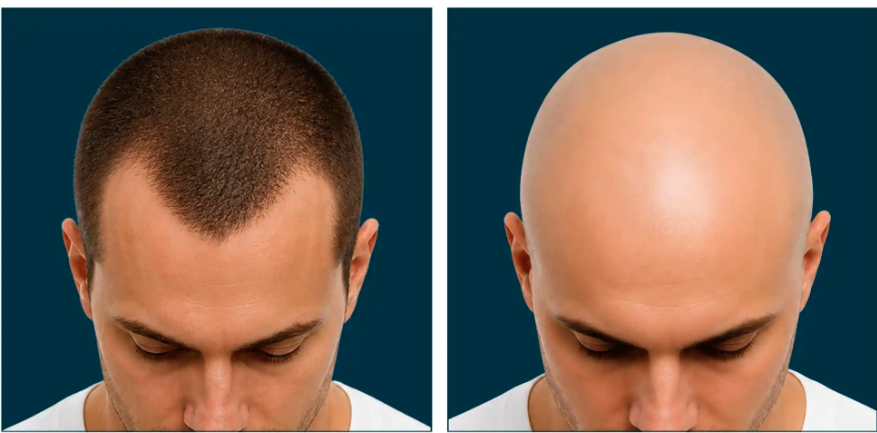
Buzz Cut vs Shaved Head for Receding Hair
Both options reduce contrast. The difference is texture, maintenance, and how much scalp you show.
Buzz cut advantages
- Keeps a shadow of hair that can soften scalp color mismatch.
- Easy to refresh with clippers at home.
- Simpler transition if you later grow hair for a procedure or trial a longer style.
- Sunburn risk is lower than a fully shaved scalp.
- Can hide very fine vellus hairs that still add a soft visual layer.
Shaved head advantages
- Maximum simplicity and uniform shine or matte scalp care routine.
- No guard line grows out unevenly between barber visits.
- Can look bold and intentional when beard is well groomed.
- Useful when remaining hair is too patchy for an even buzz.
Which looks better on a receding hairline?
There is no universal winner. Early recession with good skin tone on the scalp often suits a #2 buzz. Patchy wide loss sometimes looks cleaner fully shaved. Try a buzz one guard shorter each week before committing to daily shaving. Bring a friend or take photos in daylight before deciding.
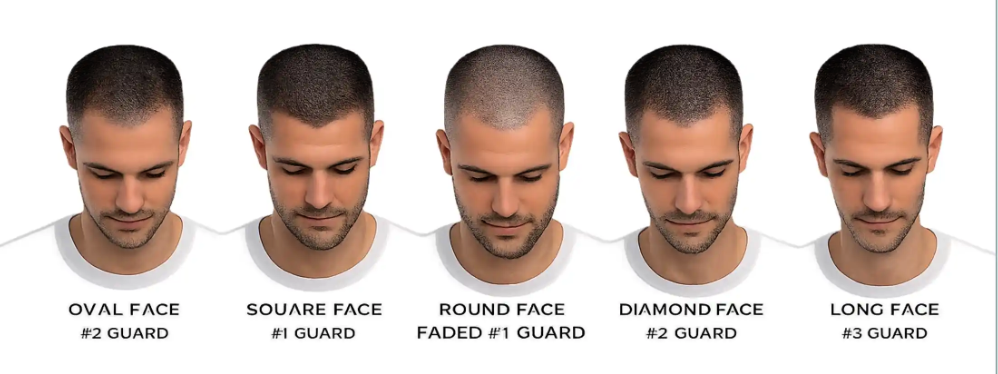
Buzz Cut by Face Shape
Face shape changes whether you should leave slightly more length on top, tighten sides, or grow a fuller beard. The buzz cut is short, but proportions still matter.
Oval face
Oval faces tolerate most buzz lengths. #1 to #3 usually work. A light temple fade is enough. You can experiment with lineup sharpness without overwhelming features.
Round face
Round faces benefit from tighter sides and a bit more height on top when density allows. A high fade with #2 on top can add vertical illusion. Avoid wide horizontal lineups at the temples that make the face look wider.
Square face
Square jaws pair well with clean #1 or #2 buzz cuts. Keep sideburn styles neat and not overly wide. A structured beard can echo the jaw without doubling width.
Long face
Long faces should avoid extreme skin fades that add more perceived height. A uniform #2 or #3 with a softer fade low on the sides often looks better. Horizontal beard lines on the chin can add width if facial hair is dense enough.
Heart-shaped face
Heart-shaped faces are wider at the forehead. A buzz cut with controlled temple fade and medium beard volume can balance a stronger upper third. Avoid ultra-short fringe that exposes a tall forehead if that is a concern.
Beard Balance With a Buzz Cut
When scalp hair is very short, the beard becomes half of the visible style. Balance is not optional.
Short beard with short buzz
Stubble to 5 mm beard length matches #0 to #1 buzz cuts. Keep cheek lines clean so the face does not look blurry. This combo suits gym-focused routines and hot weather.
Medium beard with buzz cut
A medium beard with a #2 buzz is a classic masculine pairing. Connect sideburn styles smoothly through the fade so there is no sudden jump from scalp to jaw. If the beard is patchy, a beard transplant may be discussed separately from scalp FUE, but many men look balanced without surgery.
When to reduce beard volume
If the buzz is very short and the beard is extremely heavy, the face can look bottom-heavy. Trim cheek height or reduce length under the chin. Symmetry at the neckline matters on camera and in person.
Specialists at Turkus Hair Transplant Clinic, Spain note: "I think of scalp buzz and beard as one silhouette. When patients plan a hair transplant, we talk about how facial hair will frame the new hairline months later, not only about graft placement on day one."
Fade Styles That Flatter Recession
A fade is not mandatory, but it helps many men with receding temples. The fade gradually shortens hair from top to sides, directing attention to the center and upper beard rather than empty corners.
Low fade
A low fade starts near the ear. It is subtle and professional. Good for office settings and early recession when you still want a gentle transition.
Mid fade
A mid fade sits around the temple area. It is popular with #1 and #2 buzz styles because it blends thin temple hair into skin without a harsh step.
High fade and skin fade
High and skin fades remove more side weight. They suit men who want a crisp modern look and are comfortable showing more scalp at the temples. Pair with a defined beard to anchor the jaw.
Fade mistakes on thinning hair
Avoid fades that leave a dark ring of dense side hair above a bright bald temple patch unless your barber intentionally designs a comb-over alternative. On thin hair, the fade should melt, not spotlight, recession.
Common Myths About Buzz Cuts and Hair Loss
Myth: a buzz cut stops or slows hair loss
Fact: clipping hair does not change follicle biology. DHT-sensitive follicles still miniaturize on a schedule driven by genetics and hormones. A buzz cut only changes appearance. Medical therapy or procedures may slow or restore density in some patients, but the clipper itself does not treat root cause.
Myth: shorter hair grows back thicker
Fact: cut hair feels stubbly for a few days because the blunt tip is coarse. That is not new thickness. Individual shaft diameter is set by the follicle. No guard number permanently increases it.
Myth: buzz cuts look bad on everyone with recession
Fact: most men can wear a well-proportioned buzz if guard, fade, and beard are tailored. Bad results usually come from wrong length, harsh lineups into empty temples, or ignoring face shape.
Myth: you must shave fully once recession starts
Fact: many men live comfortably at #2 or #3 for years. Others prefer shaved simplicity. Choice is personal and reversible.
Specialists at Turkus Hair Transplant Clinic, Spain note: "We welcome patients who want honest grooming advice without pressure to book surgery. A buzz cut is a valid option. We step in when goals exceed what styling can deliver or when medical therapy should be considered."
Buzz Cut Before and After Hair Transplant
Transplant patients often wear a buzz cut before surgery, during early growth, and after final results settle. Timing and clipper use should follow clinic guidance.
Before FUE or DHI
A short uniform cut helps surgeons see the hairline and plan graft distribution. Many teams ask for a buzz a few days before procedure day. Photos with the same length improve hairline design comparisons.
First weeks after surgery
Do not clip recipient areas until your coordinator clears you. Early weeks focus on gentle washing and protecting grafts. Itching and scabbing are normal within limits; scratching is not. Follow Spain aftercare instructions from your local team.
Months 3 to 12 and beyond
As transplanted hair emerges, a gradual return to buzz length is common. Some men keep a #2 forever after a successful front rebuild. Density still varies; a buzz cut does not hide a weak result the way longer styles might, so follow-up reviews matter.
Realistic expectations
A transplant may improve the hairline frame, but a buzz cut will still show scalp between hairs if density is modest. That can look natural when the plan is honest. It is less ideal if someone expected full carpet thickness. Personalized consultation sets those expectations.
Buzz Cut Mistakes to Avoid
- Going to #0 on day one without testing a longer guard first.
- Sharp lineups carved into corners where follicles are gone, creating a painted-on hairline.
- Ignoring the crown while fixing only the front in the mirror.
- Letting sides grow long while the top stays buzzed, recreating the monk halo effect.
- Skipping sunscreen on a newly exposed scalp.
- Using dull home clippers that snag and irritate skin.
- Forgetting to align beard and sideburn styles with the new scalp length.
- Assuming a buzz cut replaces finasteride, minoxidil, or PRP when a doctor recommended medical care.
- Comparing your recession to social media filters instead of daylight photos.
- Waiting years to ask for professional assessment when progressive shedding continues.
Most mistakes are fixable at the next barber visit. Persistent pattern change deserves a clinical look, not only a new guard comb.
When a Hair Transplant May Be the Better Option
A buzz cut is an excellent grooming tool. It is not the answer when your goal is to restore a frame that styling cannot recreate.
Signs grooming may no longer be enough
- You dislike your reflection even with a professional buzz and beard balance.
- Recession progresses year after year despite medical therapy where prescribed.
- The front hairline sits high enough that face proportions feel off.
- Crown thinning is visible under normal room light with a uniform #1 buzz.
- You want styling flexibility beyond very short lengths again.
- Work or personal image goals require visible density, not only clean clipping.
What transplant planning includes
At Turkus Hair Transplant Clinic in Spain, planning may include donor assessment, hairline design, graft distribution, and discussion of FUE or DHI techniques. Turkish surgical expertise supports the team; consultation and aftercare stay in Spain. We do not tell patients to travel to Turkey for surgery. Results vary; graft counts are estimates after in-person review, not online quotes.
Combining buzz cuts with treatment
Many patients continue buzzing between PRP sessions, after starting medication, or while saving for a procedure. The buzz cut and transplant path are not enemies. They are different tools at different stages.
Specialists at Turkus Hair Transplant Clinic, Spain note: "If you already maintain a great buzz cut but still feel limited, that is useful clinical information. It tells us styling is solved and density or hairline position is the remaining concern."
Why Choose Turkus Hair Transplant Clinic?
Turkus is a Turkish-led hair transplant clinic in Spain. Turkish surgical expertise is part of our team; your consultation, procedure planning, and aftercare stay local in Spain.
We focus on natural-looking results, clear communication, and personalized follow-up in Spain. We do not recommend traveling to Turkey instead of local care.
Options such as FUE, DHI, and Sapphire FUE may be suitable after evaluation. Results vary between patients; graft estimates require a consultation, not online guesses.
Specialists at Turkus Hair Transplant Clinic, Spain note: "The goal is an honest plan based on your pattern and goals, not promises that apply to every patient."
Frequently Asked Questions
Is a buzz cut good for a receding hairline?
Yes for many men. It reduces contrast, looks intentional, and is easy to maintain. It does not stop loss. Progressive recession may still need medical or surgical evaluation.
What guard length is best for thinning temples?
Norwood 2 to 3 often suits #2 or #3 with a soft fade. Advanced thinning may look cleaner at #1 or #0. Start longer and step down with your barber.
Does a buzz cut make hair grow thicker?
No. Hair may feel coarse for a few days after clipping because of blunt tips. Follicle thickness is unchanged.
Buzz cut or shaved head for receding hair?
Buzz keeps short texture and is easier to reverse. Shaved maximizes uniformity. Try a gradual step-down before daily shaving.
Can I get a buzz cut after a hair transplant?
Usually yes after your clinic clears recipient areas. Early weeks require gentle care without clipping graft zones. Follow local aftercare in Spain.
Will a buzz cut slow hair loss?
No. Only medical treatments or procedures may slow or restore loss in some patients. A buzz cut changes appearance only.
How often should I trim a buzz cut?
Every one to two weeks for a crisp look, or every three weeks for a slightly softer grow-out. Fades blur faster than uniform length.
Should I grow a beard with a buzz cut?
Many men do. Match beard length to buzz guard so the face looks balanced. Patchy beards can be groomed shorter or discussed with a specialist if framing goals are high.
What is the difference between mature hairline and receding?
A mature hairline can sit slightly higher with stable shape for years. Receding implies progressive change at temples or front. Mature vs receding review with photos helps decide whether a buzz cut alone is enough.
When should I book a consultation in Spain?
Book if recession continues despite grooming, if you want medical or surgical options, or if you are unsure whether your hairline is stable. Consultation is recommended; results vary by patient.
Get a Personal Plan for Your Hairline
A buzz cut for a receding hairline is one of the smartest grooming moves available. It is honest, low maintenance, and flexible. It works before treatment, during recovery, and after a transplant when you want a clean silhouette.
If you are deciding guard length, fade shape, or whether FUE, DHI, or PRP may suit your pattern, start with clear photos and professional feedback. At Turkus Hair Transplant Clinic in Spain, we help men separate stable mature change from progressive loss and build realistic plans without pressure.
Specialists at Turkus Hair Transplant Clinic, Spain note: "Bring three photos: front, top, and temples in daylight. Whether your next step is a #2 buzz or a consultation for hairline design, we work from facts, not myths."
Book a free consultation in Spain to review your recession pattern, discuss buzz-friendly barber goals, and explore treatment options when appropriate.